Showing posts with label art exhibition. Show all posts

Tuesday, December 27, 2022

Winter Art Residency - A Milestone, First of its kind by the Kerala Lalithakala Akademi for State Award Winners

The Travel

On short notice, I grabbed all things essential most of which were art related, pack my big bag as I intend to spend some days after the residency with my parents and depart to the airport on the warm night of 1 Oct. I was travelling alone, this time from Sharjah to Thiruvananthapuram. It was unusually crowded at the Sharjah airport. Reaching Thiruvananthapuram in the wee hours, I wait for a prepaid taxi. Kilimanoor is 40 minutes from the airport I was told; travelling to this part for the first time. I was in contact with Babuettan from the Akademi who advised me on how to reach there as well as a few general matters to take care of. Babuettan and Shijith, both Kerala Lalithakala Akademi (KLA) staff, were there to welcome and make us comfortable. Abdulla and Biji Bhaskar, two other residents, had reached the night before. Shajith and Smitha, the husband-wife duo, arrived after I reached.

Winter Art-Residency-Kilmanoor-Invite-HuesnShades

Inauguration

The residency was inaugurated by the esteemed artist, N N Rimzon, presided over by the Secretary of Kerala Lalithakala Akademi, N Balamuralikrishnan in the presence of Tom J Vattakuzhy – Executive member, KLA, T R Manoj – President, Kilimanoor Grama Panchayath, Kottara Mohan Kumar – Ward member and Latha Kurian Rajeev – General Council Member, KLA. A humble ceremony that took off with a workshop with children from the local school.

The highlight, for me, was the after-interaction we had with N N Rimzon, Tom Vattakuzhy and Latha Kurian Rajeev. It was a delight to hear their insights. N N Rimzon spoke at length about his travels, materials and memories, about national and international art, leading to a full-fledged conversation about European art and its imitation happening in Asia. Regional and aboriginal art, African art, Pop art, Bengal and Madras school, folk art and political art et al. continued in our conversations. Such engaging dialogues feed onto my senses.


Winter Art Residency Inaugural Function & Interaction-HuesnShades
Above: Esteemed artist N N Rimzon at the Inaugural address, Seated (L to R - Kottara Mohan Kumar, T R Manoj, N Balamuralikrishnan, Tom J Vattakuzhy, Latha Kurian Rajeev)
Below: an engaging conversation

Residency Space

The residency space is in the same compound of Raja Ravi Varma Gallery in Kilimanoor next to the RRV Boys School. The gallery is quite famous in the vicinity but one would be disappointed since it holds only prints of Raja Ravi Varma. If you are keen to see some originals, you need to travel to Sri Chithra Art Gallery, Thiruvananthapuram.

The high-ceiling, double-storied traditional space can house up to six artists on a twin-sharing basis on the upper floor. It has a common living space and a storeroom next to the bedrooms while kitchen, dining and caretaker’s space is on the lower floor. A beautiful structure amid trees and a rubber plantation behind which connects to the school ground. The premise also houses a stage and an amphitheater, which functions as gallery seating.  

Each room is cozily located with a pair of beds, side tables, tables, chairs and cabinets all in lovely Rubco dark wood. The ceiling is quite high and well-ventilated. The four-panelled window in the room opens into the rubber plantation. The air was quite breezy this time of the year; it was raining quite profusely some of the days! 

The only drawback, for now, is the lack of studio space. The Akademi mentioned that the facility would be opened soon.

Another major highlight was the scrumptious food they served every day with love. The Chief Chef, Aradhana with Aneesha, her assistant under the supervision of Mohanettan, took extra care to make delicious and fresh food at every mealtime. Meals matter!


Winter Art Residency Space-Kilimanoor-HuesnShades
Photo: KLA

The Residents

We were five artists from different domains.  R B Shajith and Smitha Shajith, the husband-wife duo as mentioned earlier, are artists from Kannur and Kollam respectively. Biji Bhaskar is from Muvattuppuzha, Abdulla from Thrissur, the youngest of our lot and yours truly from Palakkad/Dubai. Shajith – the measured-thinker, Smitha – peals of laughter, Biji – master of witty punch lines, Abdu – the over-thinker-laugh-instigator and I was probably the listener-observer!

We connected almost immediately. I had met Biji and Smitha earlier but they were only acquaintances until the residency. We entered into seamless conversations and discussions and our interactions were one of the cherished moments!

Now, I need to dwell on my fellow artists-residents a little longer. Each one of us is different in our practice, evidently. While I meander in mine as I mull over, reflect, watch, observe, and move at a slow pace, I saw another extreme at Shajit’s end. The rest of us looked at ‘his quarter’, jaw-dropped! He is a speed-painter and created the most works. His technique requires that pace for the abstraction he is adept at it. They are large-scale works intensely inviting into their rural scenarios; an environment he is familiar with, something that dwells around him or rather he dwells in it.

Biji is quite a detailer, his works otherworldly and his images have an earnest impact on the viewer. His colour palette is fascinating too, adding to its whimsical element. He draws inspiration from his immediate environment just like Shajit only to take on an unreal facet. He has a finesse that adds a dramatic quality to his strokes that comes from experience.

For Smitha Babu, theater is an integral part and that reflects in her works. Her themes imbue the sense of stage and the actors, the characters who inhabit the limelight and sometimes outside the limelight. Her palette is interesting too particularly the neon pink that brings light onto her canvas. Women abound in her world as well. One of the jolly lots, her laugh is infectious!

Abdulla a.k.a Abdu, our sweet brother is a non-conformer as his age demands – a Gen Z. Questions abound which resulted in both of us having some of the most interesting conversations. I wish I had a Dictaphone! That would have made amusingly candid episodes all by itself. Abdu’s mode of work is in phases – an outburst of spurring creativity and a space of linear-ticking thoughts. Questions like Who am I? Why am I? What is art? Why is art? thrive. A genius with materials, his works reflect their nuances just as his thoughts. Be it rust inking his paper, oil on his rusted metal plates or his digital collages. The only glitch is the persistent doubt he carries.

As for me, the feminine psyche and its attributes grip me. I tend to address them as "mindscapes"; an introspection into the emotional and psychological states. They deal with feminine states of being in one with the environment, reflective and surrealistic along with their internal and external struggles. Myths, dreams, visions, and people add to my interest.

Winter Art Residency-Residents-HuesnShades
Above: R B Shajith, Smitha Shajith, Deepa Gopal, Biji Bhaskar, Abdulla P A

Residency

The residency was for the duration of one month from 02 Oct to 02 Nov 2022.

Speaking about the highlights of this residency, we had complete liberty be it regarding the theme, the number of works or anything else; we were on our own. Personally speaking, this freedom gave us time for introspection, reflection, research and experimentation with subjects. I tried a couple of subject matters that had been on my mind for some time. Larger part of my works were small studies.

Remarkable supplements during the residency were the morning/evening walks we took. Each night after dinner, we played an art documentary, an Oscar-winning foreign language film, a Chaplin movie, and a couple of times some no-brainer for comic relief. We all shared a collective consciousness at this point and that was something that awed as well as humbled and linked us.

Winter Art Residency-Chitrasala-Kilimanoor Palace-HuesnShades

Winter Art Residency-Kilimanoor-HuesnShades

Winter Art Residency-Kilimanoor-HuesnShades


The silent Squad

Shijith, the overseer from the Akademi, was with us for two weeks ready to help us with whatever we needed. He used to sketch, watch movies and documentaries with us. Babuettan was extremely helpful in every aspect.

Mohanettan was one of the prominent persons in this residency. His promptness, organization and care to detail were vivid. A father-figure, he made sure that everything was done on time and that probably was one of the reasons for the smooth functioning of matters. He also cooked for us in between and his cuisine is delish! Aradhanachechi, the chief chef, I have to reinforce is an excellent cook. Mahesh spoke sparsely but functioned efficiently with materials and matters, always around to help.

The securities, Shareef and Kurupchettan, were people to remember too. The fun, the frolic, and the warmth each one of them spread helped us in our stay making it cozy and comfortable. They are the silent squad who are vital for a project to work efficiently. The people around the residency space too, have so much love, affection, warmth, and care to provide.

Winter Art Residency-Team-Kilimanoor-HuesnShades
L to R - Kurupchettan, Mohanettan, Abdulla P A, Deepa Gopal, Smitha Shajith, Biji Bhaskar, R B Shajith, Mahesh, Aneesha, Aradhana

Winter Art Residency-Kilimanoor-HuesnShades
Above: L to R (foreground): N Balamuraliktishnan, Tom J Vattakuzhy, Latha Kurian Rajeev, N N Rimzon, Babumon
Below: Shijith, R B Shajith, Biji Bhaskar, Sri Biju Raja Varma, Abdulla, Deepa Gopal, Smitha Shajith


Submission

As promised, we all contributed a work of ours to the Kerala Lalithakala Akademi at the end of our residency. Along with that work, we also submitted most of our works as requested by the Akademi awaiting an exhibition as mentioned. Hopefully, we will all be getting an opportunity to meet soon.

Gratitude

Chairman & Secretary-Winter Art Residency-Kilimanoor-HuesnShades

One of the pillars of this residency, obviously, is the Chairman, Sri Murali Cheeroth, who made it happen with the Secretary, Sri Balamuralikrishnan, and their entire team. To host such a residency is no small accomplishment. To offer a dedicated space to artists from different parts of Kerala, regional artists, to bring them together, spur interaction, and bring forth works is something extremely essential to the creative climate of any region. Such initiatives are necessary for not only the growth of the artists but also for the creative community as a whole. It sends the message that art and artists are fundamental and our contributions are valued in society. It is the embrace that each artist awaits in his/her/their career. I wish and hope that many more artists receive such opportunities to help achieve their path and make way for their aspirations.

Eminent artist Aji V N at Winter Art Residency-Kilimanoor-HuesnShades
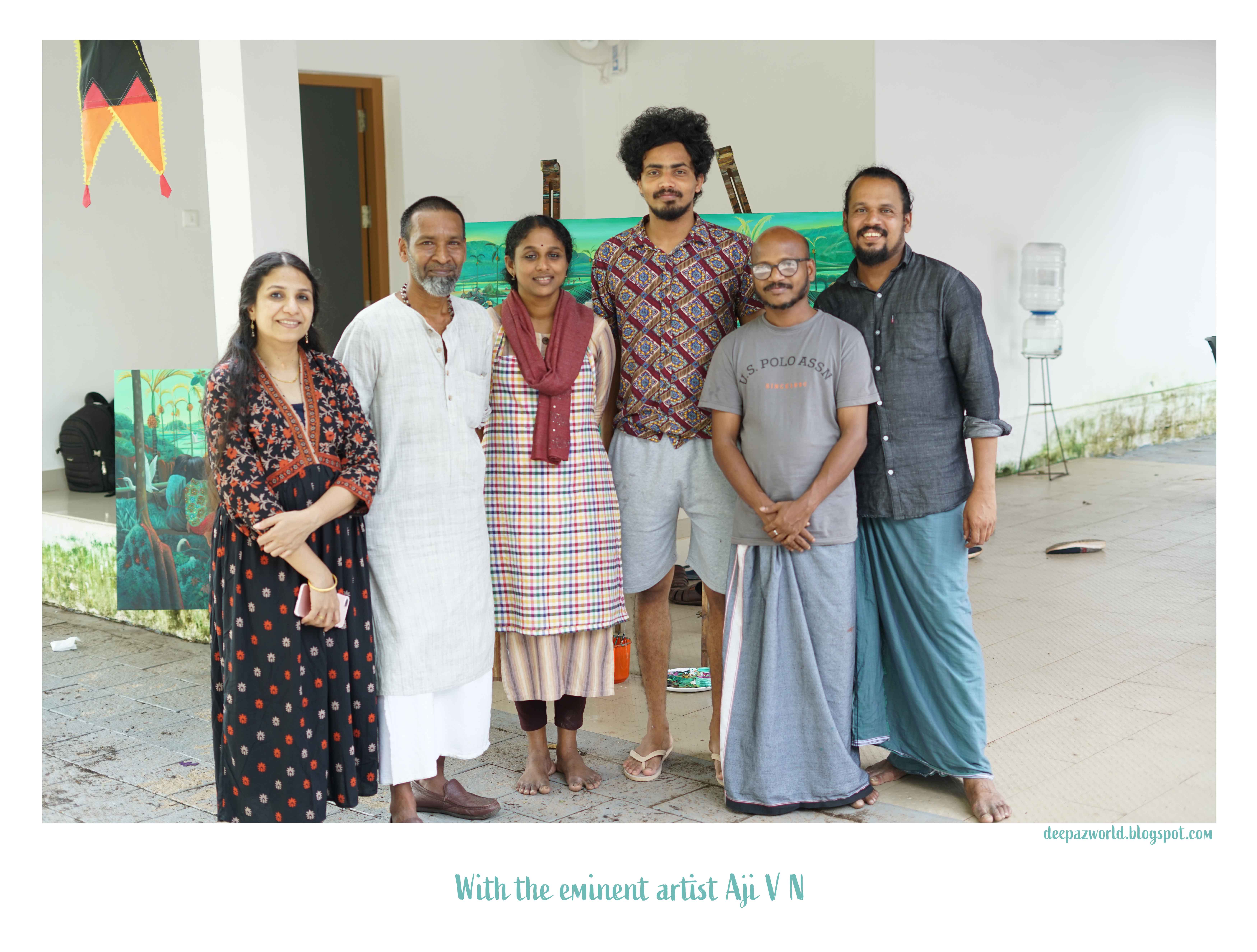
Deepa Gopal, Aji V N, Smitha Shajith, Abdulla P A, Biji Bhaskar, R B Shajith


Last but not the least; I would also like to thank the renowned artist, Aji V N, who spent a day with us. Aji put forward a slide presentation of all his major works explaining in detail his thoughts, travels, reads, colour palette, framing, et al. It was illuminating and enriched us.

Thank you Kerala Lalithakala Akademi!


Winter Art Residency-Kilimanoor-Residency Moments-HuesnShades

Friday, September 16, 2022

Khaleej Modern: Pioneers and Collectives in the Arabian Peninsula

How did art evolve in the Arabian Peninsula? What was the journey like? Who were the architects of this evolving art world? What started the different movements and where has it reached? This exhibition is a treatise, a study of these queries.

Recently I had the opportunity to attend the Preview of Khaleej Modern: Pioneers and Collectives in the Arabian Peninsula. Thanks to Arte & Lusso, the online magazine and Slava Noor, the Editor of the magazine. I must say that this is definitely a landmark exhibition with some rare and never before seen works of prominent artists from the West Asian region. It surveys the emergence of modern art in the Arabian Gulf featuring 57 artworks from the early and mid-20th century through 2007. The exhibition includes works from Bahrain, Kuwait, Oman, Qatar, Saudi Arabia, and the United Arab Emirates, a region collectively known in Arabic as the “Khaleej.”

The Exhibition that opened on 6 September at the New York University Abu Dhabi (NYUAD) Art Gallery is definitely one of a kind in recent times that explores, examines and expands our horizons in relation to the visual arts of the Arabian Gulf. Dr. Aisha Stoby with Assistant curator, Tala Nassar from the NYUAD Art Gallery and the Chief Curator of NYUAD, Maya Allison have achieved formidable feet with this path-breaking exhibition. It is curated by Dr. Aisha Stoby, who helmed the inaugural Oman Pavilion at the Venice Biennale this year.

The exhibition is based on Dr.Aisha Stoby’s Ph.D. research that commenced in 2015 as she traces and maps the evolution as well as the history of art through prominent pioneers and collectives, their definitive movements in the region’s visual art history basically the emergence of the art scene in the Arabian Peninsula. It’s extremely interesting to note that this young researcher and curator has already spent some valuable years in the study and outlining the development of almost a century. She points out the influx of teachers travelling to the region and students studying abroad which brought in a novel perception and consideration. Some of the works are on view for the first time.


Installation view of Khaleej Modern: Pioneers and Collectives in the Arabian Peninsula. “Early Pioneers” and “The Landscape” sections. Photo: John Varghese


Maya Allison- Chief Curator of NYUAD Art Gallery, Dr.Aisha Stoby and Tala Nassar - Asst.Curator


Khaleej Modern documents the shift and journey of new art theories, diverse media and curatorial framework. The backdrop of the practice was changing socio-political tendencies and contexts, extreme industrial growth and modernization. The term “modern” however takes a different affinity from European Modernism in the context of the Arabian Gulf.

The layout of the exhibition is in four segments – Early Pioneers, Landscapes, Self-Representation and Portraiture, and The Conceptual Turn. Each section is crisp yet flows gradually into the next. It starts with the artists using traditional methods from the 1940s to 2007. It’s an ongoing conversation of tradition and modernity. It involves making art as well as contextualizing it. Dr. Stoby clarifies that ‘Pioneers’ are not only artists but also include founders, gallerists, mentors, teachers and collectives where these pioneers practiced.

The Four Segments:

Early Pioneers

This section has one of the oldest paintings in the exhibition obviously. It is a portrait by Mojid Al Dosari, one of the pioneers from Kuwait who went on to study at Al Mubarakiya School. Artists in this era include Ibrahim Ismail whose work is the chosen poster image that is quite experimental and encapsulates tradition and modernity beautifully. Another work portrays an atelier where the artist presents himself painting a model and one can see the European influence and a cosmopolitan outlook present there. Mohammed Racim, one of the Turkish artists who held an exhibition in Jeddah was believed to be funded by a local Bank in the early 1950s. His illustrative works are again a mix of both tradition and modernity. Munira Al Kazi is another notable and outstanding artist of this period. They were founders and initiators of the day.


Building of Ships by Ibrahim Ismail, 1966
Oil on canvas board, 30 x 40 cm, courtesy of Barjeel Art Foundation, Sharjah


Landscapes

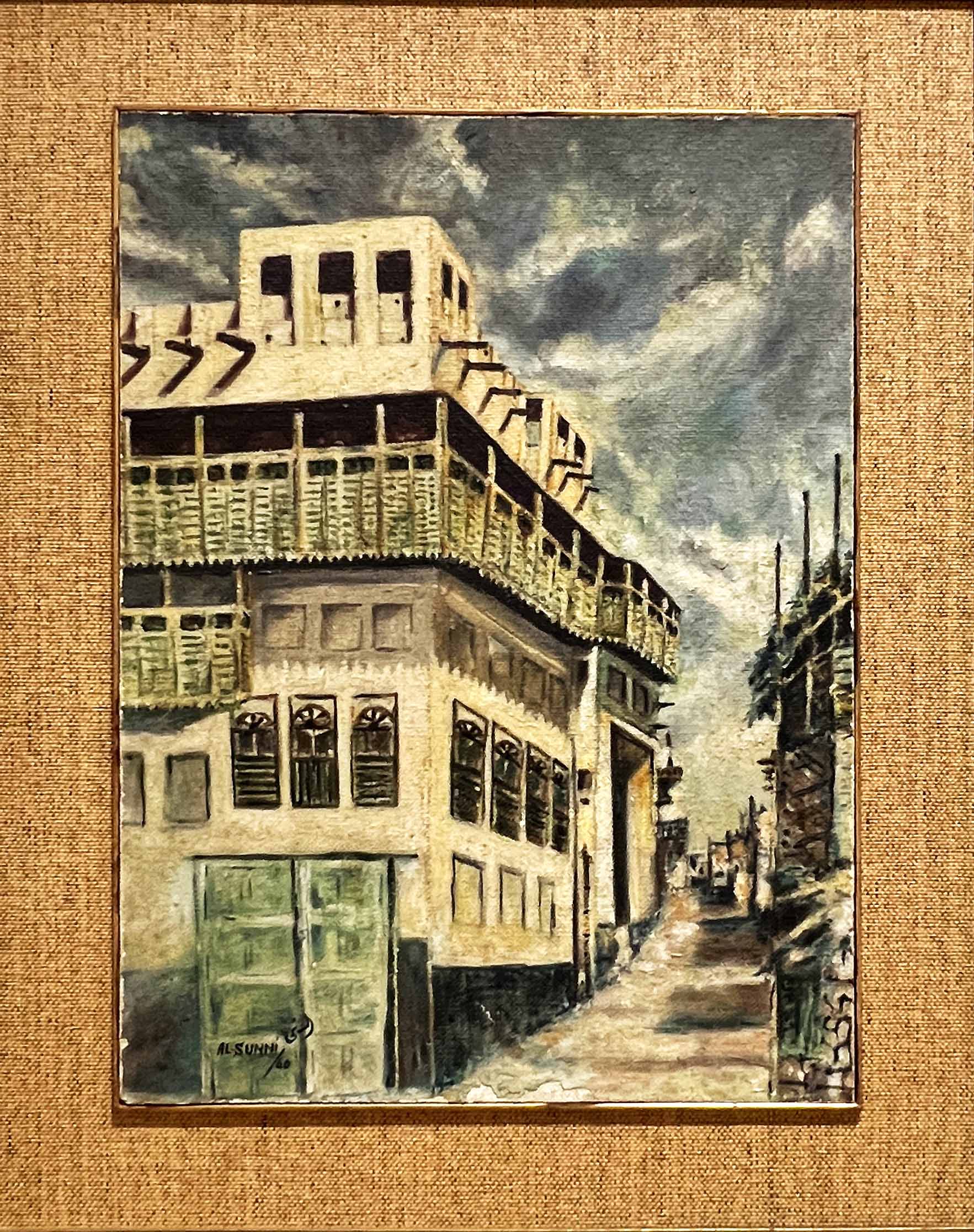
The focus in this segment is not just on the practice of architecture and landscape painting but on evolving and developing landscapes, particularly with the discovery of oil as a prominent resource. It is also about documentation, preservation, heritage and watching the shifts around them. The key artists are Ahmed Qassim Al Sunni, one of the first to receive an art scholarship from the Bahraini Government to study art in London. Along with artists like Nasser Al-Yousif and Abdul Karem Al Orrayed, Ahmed Sunni formed the “Manama Group” which met every Friday to paint the landscapes. Their style had a European influence but they focused on Bahraini landscapes. Ahmed Sunni was also the first to develop a school curriculum that became the basis of the art schools in Bahrain. Mohammed Saleem found an exhibition space where many of the artists from the exhibition had exhibited back in the day. He also coined the term “Horizonism” – taking colours and textures to emulate landscapes. Yousef Ahmad was responsible for the beginnings of the Mathaf Collection of modern art, among many other things. The other notable collective of the period is the “Three Friends” in which Yousef Ahmad was a prominent part. Many collectives and fine art societies blossomed strengthening the local art ecosystem during this period.


Old Architecture of Manama by Ahmed Qassim Al Sunni, 1960,
Oil and jute on wood, courtesy of Bahrain National Museum


Self-Representation and Portraiture

This segment is an ongoing conversation between concepts of the individual and the society, and tradition and modernity. Socio-political impact on the artistic output is strikingly visible. Along with the presence of many themes, it looks at different artistic mediums and how they were processed. A time that reflected both private and public spaces. Along with Mounirah Mosly, Safeya Binzagr pioneered in painting and exhibition. They had their one of a kind first public art exhibition in Saudi Arabia in 1968. Safeya Binzagr was the first woman in Saudi Arabia to have had a solo exhibition. Later she opened her own museum, again a first, Darat Safeya Binzagr. Her works dwell on traditions, intimate space and portraiture almost as an act of preservation. Mosly’s environment captured a constant flux of development and modernization. She also incorporated a range of materials in her diverse practice that was novel at the time. Thuraya Al Baqsami studied art in Russia and when she moved back, found that figurative painting had disappeared from the Kuwaiti art scenario. She was part of the GCC Art Friends’ Group that went against this wave. Her focus was on the lives and roles of Kuwaiti women. The Gulf War had a profound impact on the artist. Her work “Return from the village” is one that drew me in and I would have prolonged my stay in that village and would have loved to explore the place.


Al Zaboun by Safeya Binzagr, 1969
Acrylic and print on canvas, private collection


The Conceptual Turn

The final segment is not just a progression from one to another but it coincides with other dates, something that ran parallel; a period of introduction of new and different materials globally.

This section highlights the collectives “The Five” (modern and contemporary Emirati artists) and “The Circle” (a group of artists from Oman). Hassan Sharif is a major figure and there are references to his notorious One Day Exhibition held at his Mreijah Atelier in Sharjah. He is also the co-founder of Emirates Fine Arts Society. “Silsilat al Ramad”, the artists’ book by the short-lived Aqwas (“Arches” named after Sharif’s Arch-shaped works) Group that includes Hassan Sharif, Nujoom Alghanem, Khalid Albudoor and Yousef Khalil is on display. “My Mother’s Letters” by Abdullah Al Saadi is a work I was drawn to for its emotional element. This is a series of objects that his mother who couldn’t write left at his studio door to let him know that she had visited while he was away. The artist was a part of the group known as “The Five.” “The Circle” from Oman was founded by Hassan Meer whose installation “Under the Water” can be seen here. The collective focused on how to interpret spirituality using forms that one normally wouldn’t expect. Mohammed Kazem, Mousa Omar, Anwar Sonya, Budoor Al Riyami are other notable artists in this section. The artists were not only responsible for introducing and championing new artistic practices in the local communities but were also founding avenues through which this art could be studied, viewed and understood.


My Mother's Letters by Abdullah Al Saadi, 1998-2013
mixed media, courtesy of the artist


Khaleej Modern is a learning curve and a long overdue path-breaking exhibition for it could be a starting point to learn and have a deeper understanding of the times bygone in the art ecosystem of the Arabian Peninsula. Dr. Stoby anticipates that the exhibition will be a point to take forward the conversation in understanding the art scene and help in the wider reach and awareness of the times, the context and the changes – a reassessment and study of sorts. The people, the places, the process and even the patterns are a road map, a study of the past is essential to travel and evolve in the future.


Installation view of Khaleej Modern: Pioneers and Collectives in the Arabian Peninsula.“The Conceptual Turn” section. Photo: John Varghese


Exhibition Dates: Sep 6 to Dec 11, 2022
Venue: NYUAD Art Gallery, Abu Dhabi
Time: 12 to 8 pm (Mondays closed)


photo: yours truly unless specified otherwise